
GÖZCÜ: IoT Early Warning
IoT-Based Autonomous Early Warning
The hard part of early warning is not seeing the hazard; it is not being wrong. GÖZCÜ reads several senses together: one sensor's suspicion does not become an alarm; converging suspicion does.
- Operational Resilience Platform
- Network-Independent Communications
- Real-Time Crisis Management
- Powered by Türkiye's first underground data centre infrastructure
- Backed by the Ministry of Industry and Technology
How it works
Five layers. The first three complete in the field, where there is no mobile signal.
- Sensing
Several senses read the same field.
Temperature, humidity, carbon dioxide and smoke sensors, together with thermal cameras, measure the same area in different ways. A single measurement says nothing on its own; the value is in how they confirm one another.
- Edge
Most readings die in the field.
There is no high bandwidth in forested terrain; streaming raw footage to a centre would clog the network. Image processing and pre-filtering happen on the edge device the camera is attached to; only an anomaly leaves for the centre.
- Link
There is a link where there is no mobile signal.
Field units reach the centre over a long-range, low-power radio network: 10 to 15 kilometres of range in forested and rural areas with no mobile coverage. Sleep-wake cycles stretch battery life into years.
- Fusion
One sensor errs; three rarely do.
The camera's suspicion of smoke, the temperature sensor's rising trend over the last ten minutes and the area's humidity and wind data merge into a single decision. The aim is not speed but eliminating false alarms: the heat of the midday sun and the heat of a fire do not draw the same curve.
- Alarm
The alarm does not end as a notification.
Once the decision forms, the alarm is raised without waiting for human approval and opens the incident record directly. That record triggers logistics: the route for the responding crew is ready before anyone presses a key.
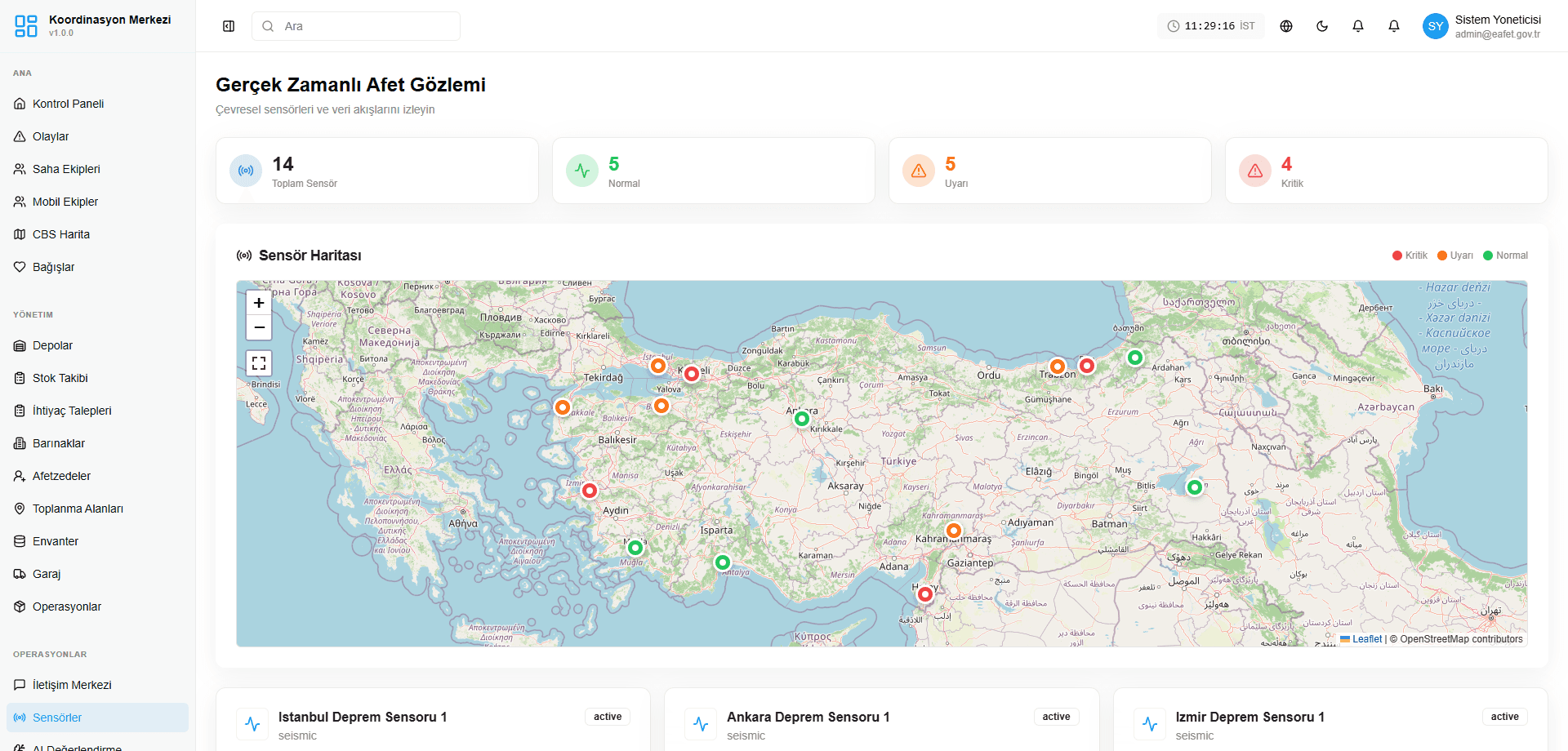
What the stations say sits on the map.
The sensor monitoring screen separates every station's state into Normal, Warning and Critical; counters on top, distribution on the map. Captured from the demo environment.
What changes
Sensors speak in forests with no mobile signal.
The decision is made at the edge; only an anomaly reaches the link.
One sensor's suspicion does not become an alarm.
The sun's heat and a fire's heat do not draw the same curve.
The alarm does not end as a notification; it becomes a route.
What you use in the field
The architecture runs in the field. This is the surface you see.
Units in the field
- Temperature and humidity sensors
- Carbon dioxide sensors
- Smoke detectors
- Thermal cameras
Hazards monitored
- Fire monitoring
- Earthquake monitoring
- Flood and rainfall monitoring
- Landslide risk
Alerting and record
- Multimodal sensor fusion
- Autonomous alarm generation
- Incident record triggered by sensor data
- Real-time data stream
This capability leads in:E-Afet CityE-Afet Defence
Let's talk about your organisation's resilience.
See E-Afet applied to your own scenario in a 30-minute demo.